Premium Wave Design Car Parking Shades Suppliers in Dubai,(UAE)
Delivering high-quality Wave Design Car Parking Shades suppliers across major UAE cities.
Search Our Car Parking Shades Services
Wave Design Car Parking Shades Suppliers in UAE | Professionals Tents & Shades LLC
Introduction
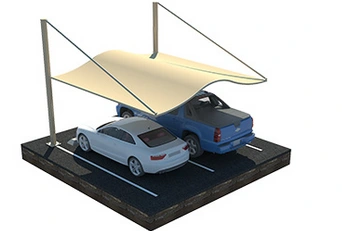
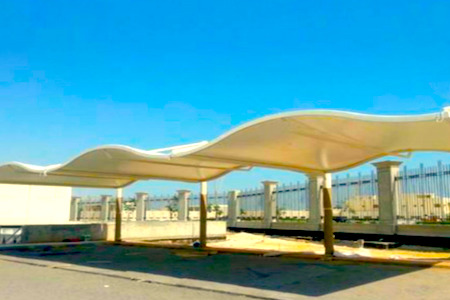
Cover a genuinely large parking area with a flat or single-arch roofline and it can start to feel monotonous fast — visually flat, structurally repetitive across every bay. Wave design shades break that up. The tensile fabric roofline rises and dips across the span in a series of high and low points, which does real structural work while also giving a large lot some visual movement instead of one unbroken plane. Professionals Tents & Shades LLC supplies and installs wave design car parking shades across Dubai, Abu Dhabi, and the rest of the UAE, for commercial complexes, large residential communities, and public parking areas where scale is part of the brief.
Wave Design Overview
A wave design shade is a tensile membrane structure, meaning the fabric itself is the primary structural element, pulled taut between high points (usually at masts or elevated frame sections) and low points (anchored lower, often at the perimeter). That alternating high-low pattern is what creates the visible "wave" — and it's not purely decorative. The undulation helps the membrane shed wind load more evenly across a large span than a flat sheet would, since the curves distribute tension in more than one direction at once.
Types & Design Options
Single-wave modules cover a defined section with one high point and one low point, useful for smaller lots or as a repeating unit. Multi-wave runs string several of these together across a long parking row, creating the continuous undulating roofline the design is known for. Peak height, wave frequency, and mast spacing all get adjusted based on span and wind exposure — a tighter wave pattern generally handles higher wind loads better, while a broader, slower wave reads as more open and architectural from underneath.
Materials & Fabrics
Masts and structural framing use T6 aluminium or hot-dip galvanized steel, joined with heavy-duty galvanized connectors sized to the tension loads a wave structure actually carries — these tend to run higher at the peaks than in a standard flat canopy. The membrane itself is typically PVC (850 GSM) with a PVDF top coat for full waterproofing and UV stability across the tensioned span, while HDPE mesh suits sites prioritizing airflow, particularly on very large lots where heat buildup under a solid membrane becomes a real factor.
Technical Specifications
| Specification | Detail |
|---|---|
| Frame Material | T6 aluminium or hot-dip galvanized steel |
| Connectors | Heavy-duty galvanized fittings |
| Fabric Options | PVC (850 GSM) with PVDF coating, or HDPE mesh |
| UV Protection | Up to 97% UV block |
| Waterproofing | Fully waterproof (PVC); water-resistant (HDPE) |
| Fire Rating | Fire-retardant certified |
| Wind Resistance | Engineered per site load requirements |
| Design Life | 15–20 years with proper maintenance |
| Customization | Wave frequency, peak height, mast spacing, colour |
Manufacturing Process
Membrane panels for a wave design get cut using tensile fabric patterning software, not a flat rectangular template — the curved, multi-directional tension across a wave shape means each panel's shape is calculated specifically for where it sits in the structure. Masts and frame components are galvanized or powder-coated in-house, sized for the peak loads at each high point rather than a uniform spec across the whole run.
Installation Process
Foundation work comes first, and it varies more here than on a flat canopy — high points typically need deeper or more heavily reinforced footings than the low points do, since that's where tension concentrates. Masts go up and get checked for plumb before the membrane is brought in. Tensioning is done in stages, working the fabric evenly across the whole span rather than pulling one section fully taut before moving to the next — rush that step and the wave pattern comes out lopsided. A final check across every high and low point happens before the structure is handed over.
Benefits & Applications
Wave structures cover large areas efficiently, often needing fewer support points per square metre than a flat canopy of the same size because the tension pattern itself does structural work. The undulating roofline also reads as a genuine architectural feature rather than pure function, which matters for developments where the parking area is visible from the street or a building's upper floors. Commercial complexes, large residential communities, festival and event grounds, and public or municipal parking areas are where this design gets used most in the UAE.
Why Choose Professionals Tents & Shades LLC
Tensile membrane structures don't forgive shortcuts the way a flat canopy sometimes can — get the panel patterning or tensioning sequence wrong and it shows immediately in an uneven wave. We calculate panel geometry and mast loads together for each project, and our own crew handles both fabrication and installation, so the same understanding of how that specific structure needs to tension carries through from workshop to final anchor check.
Dubai Coverage
Dubai's larger commercial and residential developments are where wave design shades get specified most, often for parking areas that sit in view of the main building or a public approach, where the design contributes to the property's overall look rather than sitting apart from it.
Abu Dhabi Coverage
In Abu Dhabi, we see wave designs used across government and community facility parking, and coastal exposure factors into whether we lean toward hot-dip galvanized steel for the mast structure on sites closer to the water.
We also supply and install wave design parking shades across Sharjah, Ajman, Umm Al Quwain, Fujairah, Ras Al Khaimah, and Al Ain, applying the same tensioning and panel engineering regardless of location.
Frequently Asked Questions
A handful of things come up on nearly every wave design enquiry.
Answer : The roofline itself. Instead of one curve or a flat plane, the fabric alternates between high and low tension points across the span, creating the wave shape and spreading load differently as a result.
Answer : Mostly large sites, honestly. Single-wave modules can work for something smaller, but the design's real advantage shows up across bigger, multi-wave runs.
Answer : It spreads tension in more than one direction across the membrane. That generally handles wind better than a flat sheet, though the specific rating still depends on the site.
Answer : PVC for full waterproofing and a longer lifespan. HDPE if airflow matters more, which comes up a lot on very large open lots.
Answer : T6 aluminium or hot-dip galvanized steel. Coastal sites usually push us toward steel.
Answer : Fifteen to twenty years for the frame and masts under normal conditions. The membrane gets replaced on its own separate cycle.
Answer : Yes, both fabric options, standard.
Answer : Yes. Wave frequency and peak height are both adjustable, and they change how the structure performs as much as how it looks.
Answer : We do. It's a more involved calculation than a flat canopy, and it's not something we outsource.
Answer : Longer than a flat shade of similar size, mostly because of the staged tensioning. We'll give you a real timeline after seeing the site.
Answer : Yes — Sharjah, Ajman, Umm Al Quwain, Fujairah, Ras Al Khaimah, Al Ain, all regular territory.
Answer : Periodic tension checks, especially at the high points, and an eye on mast anchors after strong wind. More attentive than a flat canopy, but not excessive.
Answer : Sometimes. Depends on the original mast and foundation capacity — we'd assess that before quoting anything.
Answer : Generally higher, given the patterning and staged installation involved. Worth discussing against your actual site and budget rather than guessing at a number here.
Answer : Send your location, roughly how much area you need covered, and any photos of the site. We'll set up a survey from there.
Get a Quote for Your Wave Design Parking Shade
If your project needs large-area covered parking that also does something visually for the property, wave design is worth a serious look. Contact Professionals Tents & Shades LLC for a site survey and a straightforward, written quotation before committing to a supplier.
Wave Design Car Parking Shades
Modern, Flexible & Large-Area Parking Shade Solution for UAE Climate
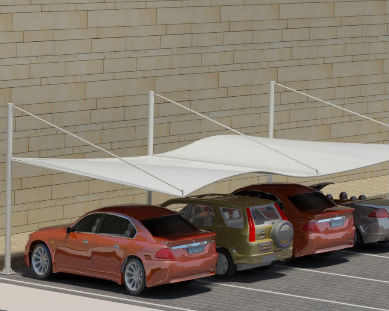
Wave Design Car Parking Shades are one of the fastest, most flexible, and most advanced car parking shade solutions available today. Known for their modern and attractive wave-style structure, these shades enhance the overall appearance of parking areas while providing maximum protection for vehicles.
Wave Design Parking Shades are the best option for covering larger areas and are widely used in commercial complexes, residential communities, festival grounds, playgrounds, and public parking spaces. Their elegant wave design offers both strength and aesthetic appeal, making them a preferred choice across the UAE.
These parking shades are manufactured using premium-quality materials such as PVC Fabric, PTFE Fabric, and HDPE Fabric, which are highly resistant to the UAE’s harsh climate. The fabrics protect vehicles from intense sunlight and increase the lifespan of cars by reducing heat exposure.
Wave Design Car Parking Shades are Flame Resistant, Tear Resistant, Dimensionally Stable, Thermally Comfortable, UV Resistant, Snow Resistant, and Wind Resistant, ensuring long-lasting durability and superior protection. Available across Dubai, Sharjah, Abu Dhabi, Ajman, Fujairah, Al Ain, and Umm Al Quwain.
Advantages of Wave Design Car Parking Shades:
- Protect windscreen from cracking.
- Protect vehicles from burning sun rays and rain.
- Maintain the gloss and shine of the vehicle.
- Keep car electronics safe.
- Reduce heat buildup inside the car.
- Ideal for large commercial and residential parking areas.
Description
Wave Design Car Parking Shades| Features | Description |
|---|---|
| Available Sizes |
Wave Design Car Parking Shades are available in different sizes and steel materials according to the requirements and parking shade design. Standard Sizes Are: • 6.0m x 3.0m (Good For 1 Car) • 6.0m x 6.0m (Good For 2 Cars) • 2.5m Open Height (Height can be modified on request) Size can be modified as per request. |
| Fabric | PVC, PTFE, and HDPE |
| Structure | MS Structure, GI Structure, and Hot Deep Galvanize |
| Color Options | White | Cream | Green | Dark Green | Dark Grey | Grey | Orange | Yellow | Black | Red | Blue | Dark Blue |
| Properties | Flame Radiant | Tear Resistant | Visual Comfort | Dimensional | Thermal Comfort | UV Resistant | Snow Resistant | Wind Resistant | Installation |
Fabric Details
Wave Design Car Parking Shade Materials
HIGH-QUALITY KNITTED UV-STABILISED HDPE FABRIC
- TEMP RANGE: -30° C TO +70° C
- 100% LEAD AND PHTHALATE FREE
- UV BLOCK RANGE: 89.3% – 97.7%
- APPROX WEIGHT: 340 GSM
- APPROX TEAR RESISTANCE: Warp 187N, Weft 359N
- WON’T ROT OR ABSORB MOISTURE
PVC – 900 GSM
- COATING: PAINTED ON BOTH SIDES (PVDF, MICRO BIOCIDE, UV PROTECTED, LOW WICK)
- TEMP RANGE: -30° C TO +70° C
- TENSILE STRENGTH: 4300 / 4200 N / 50 mm
- WATERPROOF AND FIRE RETARDANT
Our Trusted Clients
2,100+
Happy Clients
7+
Countries Worldwide
3,200+
Projects Completed
300+
Dedicated Employees
Our Service Locations
United Arab Emirates
Saudi Arabia
Qatar
Oman
Kuwait
Bahrain